
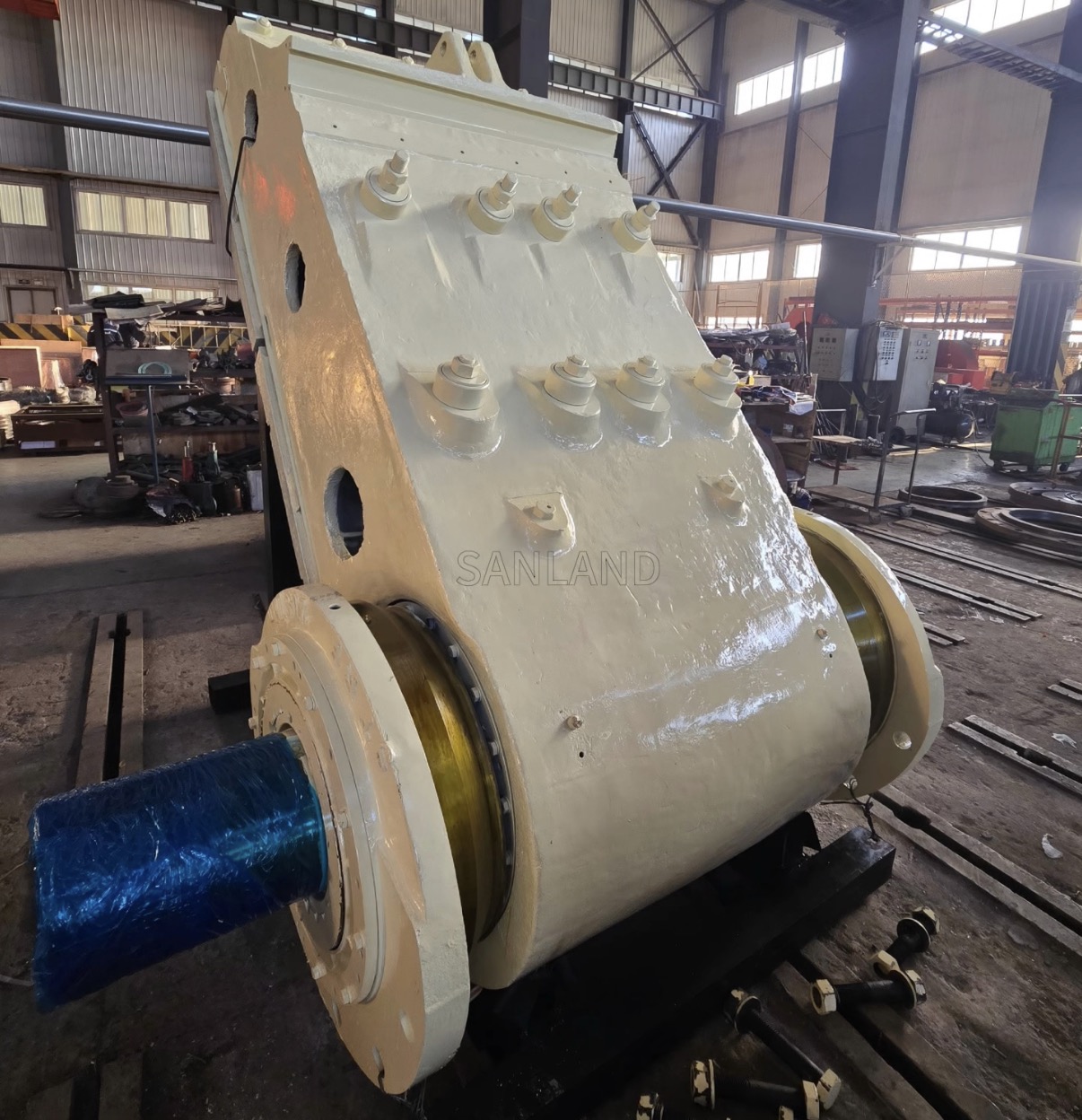
In mining crushing equipment, the jaw crusher is a key machine used in the primary crushing stage. Its performance and reliability largely depend on the design and manufacturing quality of its critical components. Among them, the moving jaw is the core component responsible for the crushing action, playing a vital role in overall machine operation.
The moving jaw is one of the main structural parts directly involved in material crushing. Working in coordination with the fixed jaw plate, it performs a periodic reciprocating motion driven by the eccentric shaft. This motion subjects the material inside the crushing chamber to compression, splitting, and bending forces, achieving effective primary size reduction. The motion trajectory and structural design of the moving jaw directly influence crushing efficiency and product size distribution.
Structurally, the moving jaw is typically manufactured as an integral casting or welded structure using high-strength materials to ensure excellent fatigue resistance under heavy impact conditions. The surface is fitted with a movable jaw plate, which is secured by bolts or wedges for easy replacement and maintenance. At the same time, the moving jaw must maintain precise alignment and fitting with components such as the bearing housing and eccentric shaft to ensure smooth operation and balanced load distribution.
During manufacturing, the moving jaw undergoes multiple processes, including casting or fabrication, heat treatment, and precision machining. Proper heat treatment enhances strength and toughness, while accurate machining ensures dimensional precision and alignment of critical interfaces. Strict quality inspection and assembly control further guarantee the performance and durability of the component.
In mining operations, jaw crushers are primarily used in the primary crushing stage, where large run-of-mine materials are reduced to a size suitable for secondary crushing or grinding. As the core moving component, the performance of the moving jaw directly affects processing capacity, operational stability, and equipment lifespan.
As mining equipment continues to evolve toward higher efficiency and larger scale, greater demands are placed on the strength and precision of key components. A high-quality moving jaw not only improves overall equipment performance but also reduces failure rates and maintenance costs, ensuring stable and efficient operation.
We warmly welcome your inquiries and look forward to providing professional technical solutions and competitive quotations.


Ember: +86 15940027485
kimosales@sanlandmet.com

Ember: +86 15940027485
kimosales@sanlandmet.com

Юлия: +86 17612428726
17612428726@sanlandmet.com

Tel:+86 15940027485
Email:kimosales@sanlandmet.com