
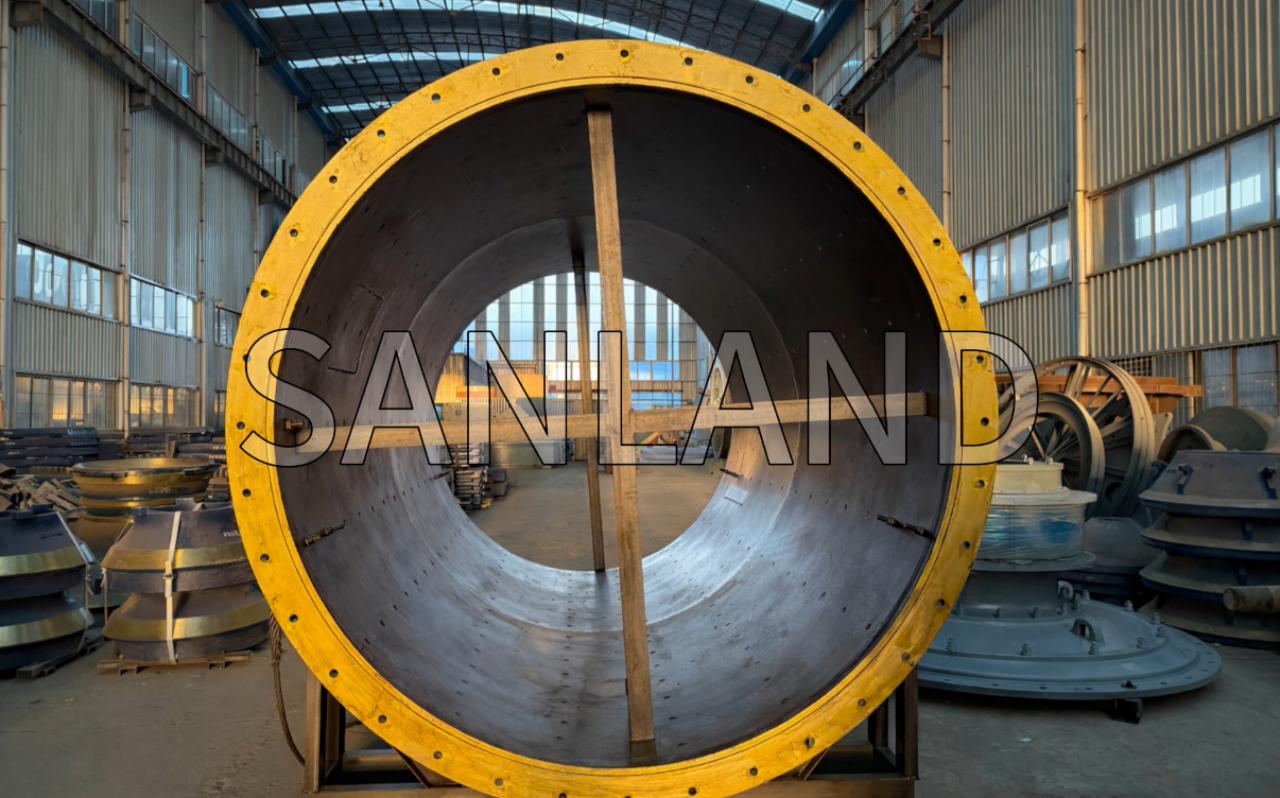
 During the manufacturing and delivery of large ball mills, shell transportation is a critical yet often overlooked stage. When the length of a ball mill shell exceeds a certain limit, its structural behavior under transportation conditions differs significantly from that during normal operation. To ensure structural integrity and dimensional accuracy, internal cross bracing is commonly applied during transport.
Extra-long mill shells are subjected to complex stresses caused by self-weight, lifting operations, road vibrations, and uneven support during transportation. Without proper internal reinforcement, these stresses may lead to slight deformation of the shell, including loss of roundness or localized ovality. Although such deformation may not be immediately visible, it can negatively affect gear meshing accuracy, shaft alignment, and long-term operational stability once the mill is installed.
Internal cross bracing effectively distributes internal stresses and increases the overall rigidity of the shell, helping maintain its geometric precision throughout the transportation process. In addition, this reinforcement minimizes the impact of vibration on welded joints and shell structures, providing strong protection for critical components before site installation and commissioning.
At Shenyang Sanland Mining Engineering, transportation protection is treated as an integral part of equipment quality control. From structural design to manufacturing and logistics planning, each delivery solution is carefully engineered to ensure that large-scale ball mill components arrive at the customer’s site in optimal condition.
For more information on large grinding equipment manufacturing and delivery solutions, please feel free to contact us.


Ember: +86 15940027485
kimosales@sanlandmet.com

Ember: +86 15940027485
kimosales@sanlandmet.com

Юлия: +86 17612428726
17612428726@sanlandmet.com

Tel:+86 15940027485
Email:kimosales@sanlandmet.com